

COSPHADERM® LECITHINS - Natural emulsifiers
Order a free sample now: If you would like to start a new formulation with our Cosphaderm® lecithins, our experts will be happy to advise you free of charge. Together we will find the right solution for your products
THE ADVANTAGES AT A GLANCE
100% natural
and vegan
Emulsifying
Regenerating, protecting
the skin barrier
Create a silky
Skin feel
Flexible use
COSPHADERM®
LECITHINE
Lecithins are valuable raw materials in the cosmetics industry. With their multifunctional properties, they not only contribute to the stability of emulsions, but also improve the sensory qualities of formulations, optimise the moisturisation of the skin and support modern formulation approaches such as clean beauty and natural cosmetics.
Our high-quality lecithin products are precisely tailored to the requirements of modern cosmetic formulations. They offer reliable performance and can be flexibly integrated into sophisticated formulations. Whether for innovative skin care, Decorative cosmetics or hair care - lecithins enable the development of sustainable and high-performance products.
What are lecithins?
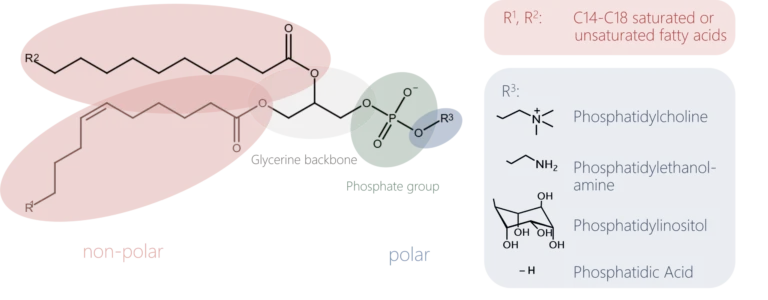
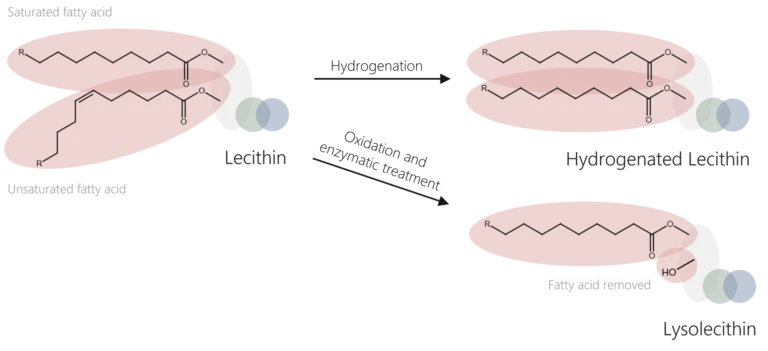
Lecithins consist to a large extent of phospholipids. Phospholipids occur naturally in biological membranes. They consist of a glycerol backbone to which three residues are bound. They differ firstly in their phosphate-bound organic residues (e.g. -choline, -ethanolamine, -inositol) and also in their two different fatty acids bound to glycerol. These can be saturated or unsaturated. In the case of lysolecithins, a fatty acid is split off enzymatically. In the case of hydrogenation, unsaturated fatty acids become saturated fatty acids.
PHOSPHOLIPIDS - STRUCTURE
LECITHIN TYPES AND MODIFICATION
Why lecithins in cosmetics?
Lecithine are far more than an excipient - it are Raw materiale with added value. In addition to stabilisingng cosmetic products trthey actively contributes to the care and improvement of skin health. In additionthem seamlessly into sustainable concepts and supportsen This is how the growing demand for environmentally conscious solutions can be met. In the The following the various areas of application and advantages are broken down.
1. Co-Emulsifieren for stable formulations
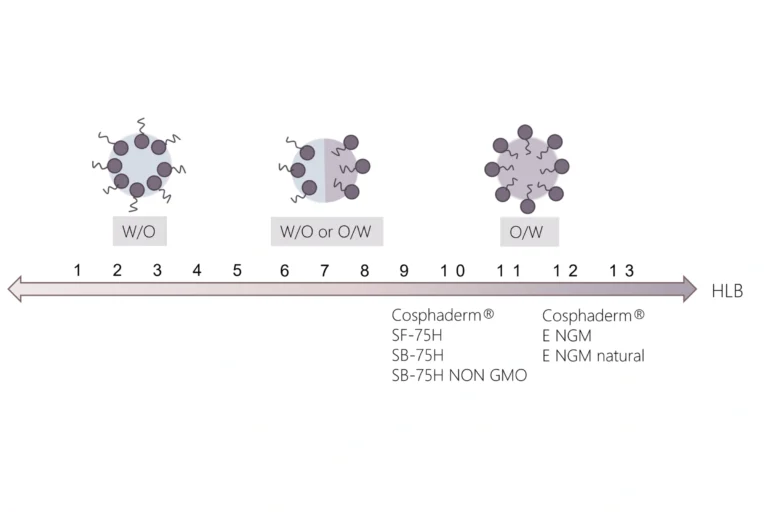
Thanks to their amphiphilic structure, phospholipids are ideal natural emulsifiers and co-emulsifiers. Lecithins combine well with other emulsifiers and improve not only the stability of cosmetic products but also the texture of formulations. They give cosmetic products a pleasant, non-sticky texture and ensure a rich, silky skin feel. Whether oil-in-water (O/W) or water-in-oil (W/O) emulsions, our various lecithins enable reliable stabilisation. Another major advantage is that lecithins can be used in cold formulations. They also support the dissolution of challenging ingredients such as ascorbyl palmitate.
LECITHINS AS (CO-)EMULSIFIERS
2. moisturiser and skin- and haircare through natural phospholipids
Lecithine containold a high concentration of natural phospholipids, which resemble the structure of skin lipids. These generate in the skin bilamellare structures, imitating cellular membranes, and improve so the function of the skin barrier, which contributes to long-term moisture retention. In hair care, lecithins help to make hair easier to comb when they are used in conditioners, among other things, and have an antistatic effect. This is why lecithins are often used as caring Active used in skin and hair care.
3. sustainability and compatibility with OrganicCosmetics
In an industry that is increasingly focussing on sustainability and naturalness, lecithin is an ideal raw material.
*Natural origin:
Our lecithins are obtained from renewable, plant-based sources such as soya or sunflowers.
*Sustainability certifications:
The majority of our lecithins comply with COSMOS, NATRUE and Non-GMO standards and can be used in natural cosmetics without any problems.
*Clean beauty trend:
It fulfils the requirements of modern „green“ product lines as it is biodegradable, skin-friendly and free from synthetic additives.
Our Cosphaderm® lecithins at a glance
Our lecithin portfolio covers a wide range of possible applications, that are specifically tailored to the requirements of modern cosmetics. From stabilising properties to specific skin care benefits - each lecithin offers a solution for specific challenges in cosmetic applications. Formulations.
Cosphaderm® E NGM & Cosphaderm® E NGM natural
(Lysolecithins)
Liquid lysolecithin is ideal as a co-emulsifier for light, skin-caring textures that do not require a viscosity build-up, such as body milk. Cosphaderm® E NGM natural is the ideal choice for natural cosmetic products that require COSMOS compliance.
Application tip:
Perfect for formulations with a low oil or high water content. With an HLB value of 10-13, it can be ideally incorporated into the warm water or oil phase. In cold processing, it can even be added after emulsion formation.
Dosage:
The recommended dosage is between 0.5 and 5.0 %, depending on the desired stability. As a co-emulsifier, 0.5-1.0 % is sufficient, while it is used as the sole emulsifier at 2-5 %. In bath products such as bath oils, the proportion can even be up to 10 %.
Technical advantages:
Due to its increased polarity as lysolecithin, it disperses particularly well in water and also promotes the skin penetration of active ingredients. In shower gels and hair care products with a pH value below 5, it also provides a moisturising and nourishing effect.
Cosphaderm® SF-75H & Cosphaderm® SB-75H / SB-75H NON GMO
(Fractionated hydrogenated lecithins)
Thanks to the powder form, the raw material is particularly easy to handle. Cosphaderm® SF-75H is extracted from sunflowers and complies with COSMOS and NATRUE standards, while Cosphaderm® SB-75H based on soya. Cosphaderm® SB-75H NON GMO comes from guaranteed non-genetically modified soya and is therefore also COMOS and NATRUE compliant. The phosphatidylcholine content has been increased to at least 70 % through fractionation, which further improves the effectiveness.
Processing:
It is incorporated into the water phase for processing. The HLB value is between 9 and 12.
Dosage:
The recommended dosage is between 1.0 -3.0 %.
*As co-emulsifier between 0.5-1-0 %
*As sole emulsifier at 3.0 %.
Technical advantages:
The raw material has minimal influence on the appearance and odour of the formulation. Due to its hydrogenation, it is also less susceptible to oxidation, which improves the stability of emulsions and even enables the formation of liposomes.
Thanks to the structure of hydrogenated lecithins, a more compact and stable interface is created, which improves the stability of emulsions and enables the formation of liposomes.
Cosphaderm® Lecithine - Application tips
Lecithins are natural substances that are sensitive to heat. To achieve a stable, homogeneous emulsion and preserve the functionality of the lecithins, the following points should be observed:
*Use rotor-stator homogeniser
*It is possible to use lecithins in cold storage.
Solubility:
Oil soluble, water dispersible
Heating:
Short-term heating up to 70 °C is possible. We recommend avoiding prolonged heating above 70 °C.
Viscosity development:
An increase in viscosity can typically be observed after 1-2 days.
Storage:
Lecithins should be stored in a cool, dry place to ensure stability.
FORMULATIONS WITH
COSPHADERM® LECITHIN
Cosphatec offers various lecithins depending on customer requirements. Here you will find two exemplary trend formulations. You can find further inspiration in our formulation overview.
Curious?
Order a free sample now: If you would like to start a new formulation with our Cosphaderm® lecithins, our experts will be happy to advise you free of charge. Together we will find the right solution for your products
