

CHALLENGES OF MICROBIOLOGICAL SAFETY
Burkholderia cepacia and Pluralibacter gergoviae are microorganisms whose contamination poses a particular challenge for the cosmetics industry, especially in terms of quality assurance in production facilities and product safety for cosmetic products.
Burkholderia cepacia is a gram-negative bacterium that belongs to the so-called Burkholderia cepacia complex (BCC). This group comprises several closely related species that are characterised by high environmental resistance and adaptability. In the cosmetics industry B. cepacia is particularly feared as it can have a biofilm-forming effect in water-based products and production facilities. This makes decontamination more difficult and increases the risk of cross-contamination. The bacterial resistance to many preservatives and biocides makes it particularly difficult to control in cosmetic products. In addition, this bacterial strain is known for the so-called phoenix effect: the microorganisms cannot be detected in the end product immediately after production, but then form colonies after some storage time.
Pluralibacter gergoviae, formerly known as Enterobacter gergoviae, is an opportunistic pathogen that is also frequently found in cosmetic products. It shows an astonishing resistance to certain preservatives, such as parabens, which are frequently used in the cosmetics industry. P. gergoviae is often isolated in connection with moisturising cosmetics such as creams and lotions and represents a major challenge for product safety.
Monitoring for B. cepacia and P. gergoviae is crucial for quality assurance in production facilities, as contamination can be potentially harmful to health and contaminated end products can affect consumer confidence. To contain these microorganisms, manufacturers of cosmetic products rely on optimised hygiene measures and the testing of production water during production. However, adapting the preservation system of the cosmetics produced can also be considered as a measure.
STUDY ON THE EFFECTIVENESS OF PRESERVATIVES
As a manufacturer of natural antimicrobial multifunctionals and preservatives, our aim is to provide safe and effective solutions to control microbiological contamination in cosmetic products for our customers, who have approached us many times in the past with problems of this nature. In view of the particular resistance of Burkholderia cepacia and Pluralibacter gergoviae Compared to many conventional preservatives, we conducted a comprehensive study to evaluate the efficacy of various antimicrobial multifunctionals from our portfolio against these strains. Several preservatives were tested in modified preservative challenge tests (KBT) for their efficacy against each of five different strains. B. cepacia and five P. gergoviae-strains were tested. These were one ATCC strain and four strains isolated from industrial samples. The antimicrobial multifunctionals were incorporated into an O/W emulsion with pH 5.5 at a suitable application concentration and inoculated with the bacterial strains on day 0 of the test, analogous to a CFT in accordance with ISO standard 11930. Bacterial growth was checked after 7, 14 and 28 days. The following table shows the results of the modified preservation load tests
Effectiveness of preservatives against the bacterial strains B. cepacia and P. gergoviae according to mod. ISO 11930.
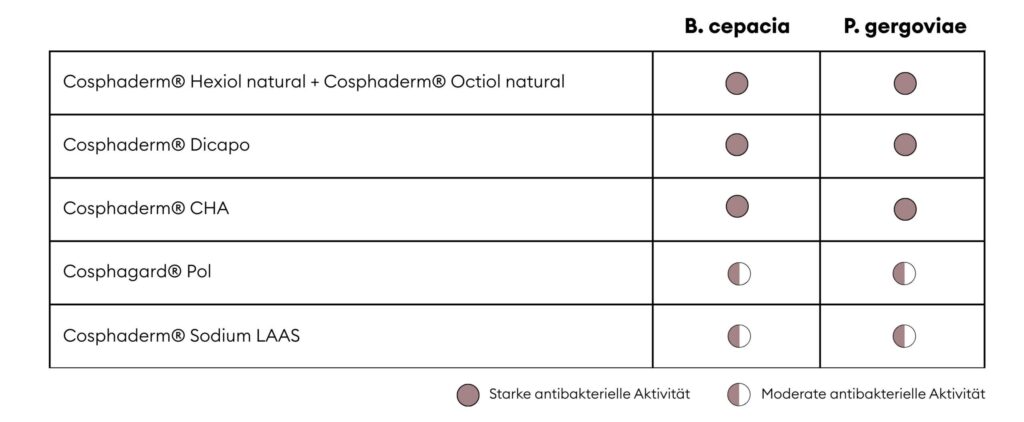
The results of our study show that all tested antimicrobials are able to inhibit the growth of the B. cepacia- and P. gergoviae-strains can be significantly inhibited or completely eliminated in an emulsion. This result confirms that optimised combinations of active ingredients can also be used to effectively preserve these challenging strains. However, we are aware that the results of this test do not allow a generalised statement to be made about the effect against mutation-prone bacteria. Each contamination is an individual case with a potentially already preservation-resistant bacterium that must be treated individually. However, improving the preservation system in combination with, for example, chemical sanitisation of the production equipment can be a sensible measure in the fight against these troublesome production germs.
PREVENTIVE MEASURES AND CONTROL STRATEGIES
The control of Burkholderia cepacia and Pluralibacter gergoviae requires a holistic approach, ranging from precise test methods and optimisation of production conditions to improved product formulation. We will be happy to support you in selecting suitable preservatives and multifunctionals from our portfolio if you are experiencing problems with Burkholderia cepacia or Pluralibacter gergoviae-contamination and also want to benefit from the other advantages of our multifunctionals for your formulations. For further information or a detailed study report, please do not hesitate to contact us.
