

POWER PROTECTION
COSPHADERM® TOCOPHARIN
Would you like to test the ideal combination of tocopherol and carnosolic acid in your formulations?
No problem! We will gladly send you a free sample of Cosphaderm® Tocopharin to.
THE ADVANTAGES AT A GLANCE
Odourless liquid
Improved
Product protection performance
COSMOS and
NATRUE-tested
Suitable for various
Formulation types
pH-independent
Multifunctionality for
Skin and formulation
Protects the skin from damage caused by oxidative stress
COSPHADERM®
TOCOPHARIN
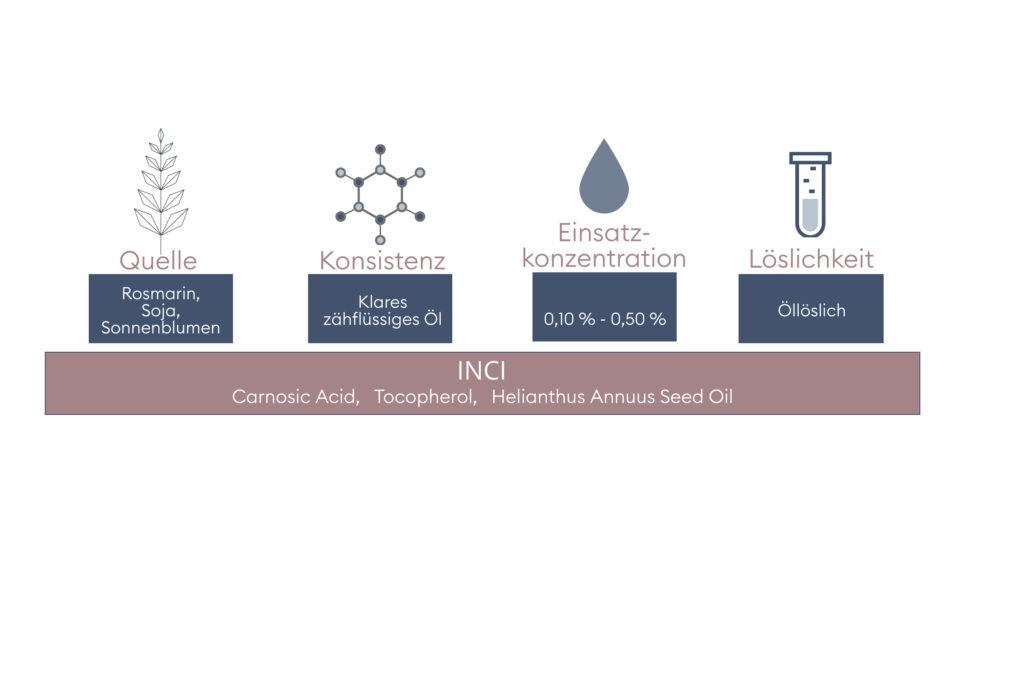
Cosphaderm® Tocopharin is composed of the natural antioxidants tocopherol and carnosolic acid dissolved in sunflower oil. It is an antioxidant blend that combines the protection of the oil phase of the formulation with a positive influence on oxidation processes in the skin and does not change its smell or colour when incorporated into formulations.
What does Cosphaderm® Tocopharin consist of?
The included tocopherol mixture contains a high proportion of γ-tocopherol and thus ensures excellent protection of the oil phase of the formulation. Carnosolic acid is extracted from rosemary (Rosmarinus Officinalis) is obtained. The rosemary extract incorporated in Cosphaderm® Tocopharin has a carnosolic acid content of at least 90%. Carnosolic acid thus not only supports the protection of the oil phase, but also provides the skin with a pronounced protection against oxidative processes.
What makes carnosolic acid so special?
Carnosolic acid is a phenolic diterpene found in rosemary and has long been valued for its bioactive properties. Of all the constituents of rosemary, carnosolic acid is one of the key components that give the plant its antioxidant and anti-inflammatory properties.
Effects on formulations
Cosmetic formulations containing oils must be protected against visual and odour impairment caused by oxidative processes. Due to the combination of the two antioxidant substances tocopherol and carnosolic acid, only low application concentrations from 0.1 % Cosphaderm® Tocopharin necessary to ensure excellent product protection. The carnosolic acid it contains impairs the formation of rancid odours due to oxidation processes, which improves the shelf life of products with lipid components. In addition, the combination of the two antioxidant components within a product ensures a lower necessary concentration of active substances compared to pure tocopherol while maintaining the same antioxidant effect.
Improved oxidation stability
The outstanding effectiveness of Cosphaderm® Tocopharin in protecting oils against rancidity was demonstrated in Rancimat tests in comparison with the industry standard mixed tocopherol (Fig. 1). The relative change to untreated sunflower oil when using the antioxidants is shown here. The improvement in oxidation stability with 0.2 % mixed tocopherol is clearly recognisable. At the same concentration, a further increase in stability of 25 % can be achieved with Cosphaderm® Tocopharin. With an equivalent amount of tocopherol, the influence of carnosolic acid is clearly emphasised. The corresponding application concentration of 0.68 % Cosphaderm® Tocopharin leads to a threefold increase in oil stability.

Figure 1: Determination of oxidation stability via Rancimat test at 100 °C according to method §64 LFGB L13.00-38:2010-01. Relative improvement of induction time compared to untreated sunflower oil by 0.2 % mixed tocopherol (green), 0.2 % Cosphaderm® Tocopharin (blue) or 0.68 % Cosphaderm® Tocopharin (red).
Effects on the skin
Antioxidants play a crucial role in cosmetic products as they protect the skin from oxidation-induced damage and the associated signs of ageing. As a natural component of many plants, antioxidants neutralise free radicals with the help of their radical scavenging or electron donor properties, rendering them harmless. According to Loussouarn, the antioxidant effect of carnosolic acid is based on et al. (2017) on chemical quenching of reactive oxygen species (ROS).1 Cosphaderm® Tocopharin effectively utilises the antioxidant properties of its two ingredients tocopherol and carnosolic acid. Carnosolic acid in particular helps to protect cells from oxidative stress caused by environmental pollution and UV rays.
Protects the skin from UV damage
To maximise the antioxidant effect of Cosphaderm® Tocopharin in the skin, a in vitro-study, in which the amount of reactive oxygen species in human keratinocytes was measured. These skin cells were incubated with the test samples for 24 hours and then exposed to UV radiation to induce the formation of reactive oxygen species (ROS) and then measure their reduction. The positive effect of Cosphaderm® Tocopharin becomes clear in comparison to the reference materials mixed tocopherol and the synthetic standard antioxidant butylhydroxytoluene (BHT), which were each used in the assay at the same concentration (Fig. 2).
The synthetic antioxidant BHT and the mixed tocopherol show comparable performance at 0.003 %. At the same application concentration, Cosphaderm® Tocopharin can significantly reduce the formation of ROS through UV irradiation. Compared to the untreated sample, Cosphaderm® Tocopharin can reduce the ROS level by 26 %. These results confirm a pronounced skin cell-protecting effect of Cosphaderm® Tocopharin against UV-induced oxidation processes.

Figure 2: Fluorimetrically determined relative ROS quantity in human keratinocytes after 24-hour incubation with the test substances and subsequent two-hour UVA irradiation. Samples: untreated UVA-irradiated control (violet), BHT (red), mixed tocopherol (green), Cosphaderm® Tocopharin (blue). Statistical significance is shown with * for p < 0.05.
When the skin is exposed to UV radiation, the upregulation of matrix metalloproteinases breaks down extracellular matrix proteins such as collagens, which leads to a long-term loss of skin elasticity and thus represents a further natural factor in photoageing. In the scientific literature on carnosolic acid, however, there is further evidence of its photoprotective properties¹. Thanks to the inhibition of matrix metalloproteinases by carnosolic acid, which has been proven in studies, photoageing can be actively prevented².
Anti-inflammatory and antimicrobial properties for sensitive skin
Carnosolic acid provides further benefits for the skin. Its anti-inflammatory properties manifest themselves, for example, in the suppression of interleukin release and the blocking of the Syk/Src signalling pathway3. Skin care products containing this compound can help reduce redness4 and restore skin homeostasis. As an antimicrobial, carnosolic acid can also inhibit the growth of bacteria such as P. acnes and S. aureus5 inhibit. This makes it suitable, for example, for cosmetic applications to help combat skin blemishes caused by acne6.
Curious?
Would you like to test the ideal combination of tocopherol and carnosolic acid in your formulations?
No problem! We will gladly send you a free sample of Cosphaderm® Tocopharin to.
FORMULATIONS WITH
COSPHADERM® TOCOPHARIN
Discover our innovative Cosphaderm® Tocopharinformulations based on natural, skin-friendly raw materials. The combination of tocopherol and carnosolic acid not only ensures high efficacy, but also stable cosmetic formulations.
Anti Pollution Serum
Colour & Care Lipstick
Sources:

1. Offord, E.A. et al, Free Radic Biol Med. 2002, 32(12), 1293-1303.

2 Park, M. et al, Exp Dermatol. 2013, 22(5), 336-341.

3 Oh, J. et al, Mediators Inflamm. 2012, 781375.

4 Reuter, J. et al, Planta Med. 2007, 73(11), 1190-1191.

5 Tada, M. et al, Chem Pharm Bull (Tokyo) 2010, 58(1), 27-29.

6 Birtić, S. et al, Phytochemistry, 2015,115, 9-19.
